Recreating Hi8
June 30, 2023
Back in high school I was mesmerized by the aesthetic of Hi8 camcorders and sought to recreate their look by first understanding how the medium physically functioned. Here are my old notes on the subject:
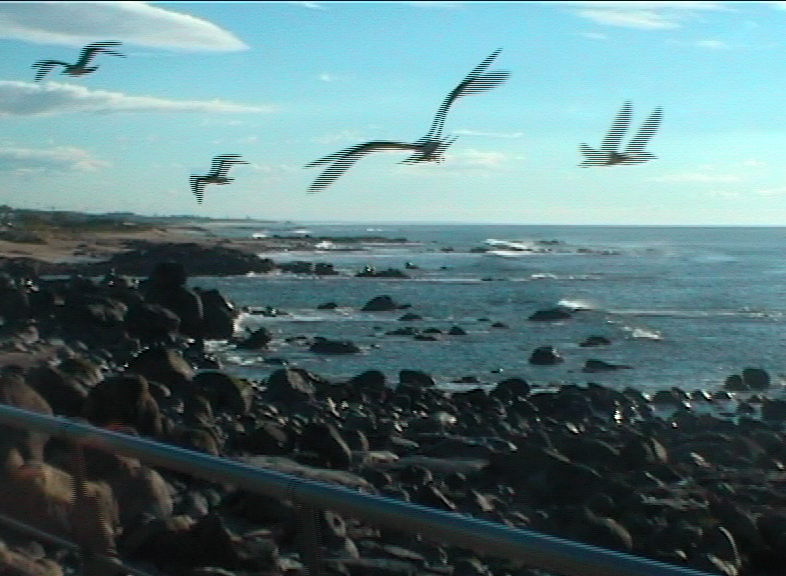
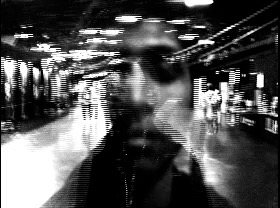
Hi8 is an analog video format that's recorded onto 8mm magnetic tape [1]. The hallmark of almost every magnetic tape video format is that footage is scanned using interlaced scanning (i). Modern digital cameras record using progressive scanning (p). This is why today we use 1080p, but before it was 480i.
Interlacing is what gives Hi8 its distinct deinterlacing artifacts [2]. In interlaced scanning we capture a frame by scanning alternating rows from top to bottom. In one frame we may start scanning the odd-numbered rows and then in the next frame we scan all the even-numbered rows, alternating which lines to record from between each frame. Progressive scanning, which is what all modern cameras now use, record each line sequentially without skipping any rows. By recording alternating rows of pixels per frame, when rendering the video, two distinct frames are interlaced together, stitching their alternating rows to produce the final image. In the case there is a big transition or significant motion between frames, a visual artifact will appear where it looks like you are seeing one frame being displayed in one of the series of rows while the next highly contrasting frame appears to bleed through the image in the alternating row pattern it was scanned, creating the deinterlacing artifact.
Interlacing was created as a more bandwidth efficient form of video capture during the age of the CRT display. When displaying an image on a CRT using interlaced scanning, our vision perceives a full picture despite the fact only half the pixels would be activated per frame. Effectively, interlacing allows us to cut the bandwidth needed to display a video stream in half.
Properties of Hi8
- Interlaced scanning, not progressive
- 3:2 or 4:3 aspect ratio
- Low resolution (240i, 360i, 480i)
- Very low bitrate (compression creates color artifacts)
- Low dynamic range (compress highlights, whites are a very light gray not a pure white)